
From Idea to Published: Tiffany North’s Journey to Becoming an Author
Last updated: September 29, 2025
Like many clients, Tiffany North approached me with an idea for a nonfiction book but no idea how to turn her idea into an engaging book. Through her experience as an an R.N. and her work as an Intuitive Eating Coach, she’d developed an entire framework around using attachment theory in healing one’s relationship with food and body.
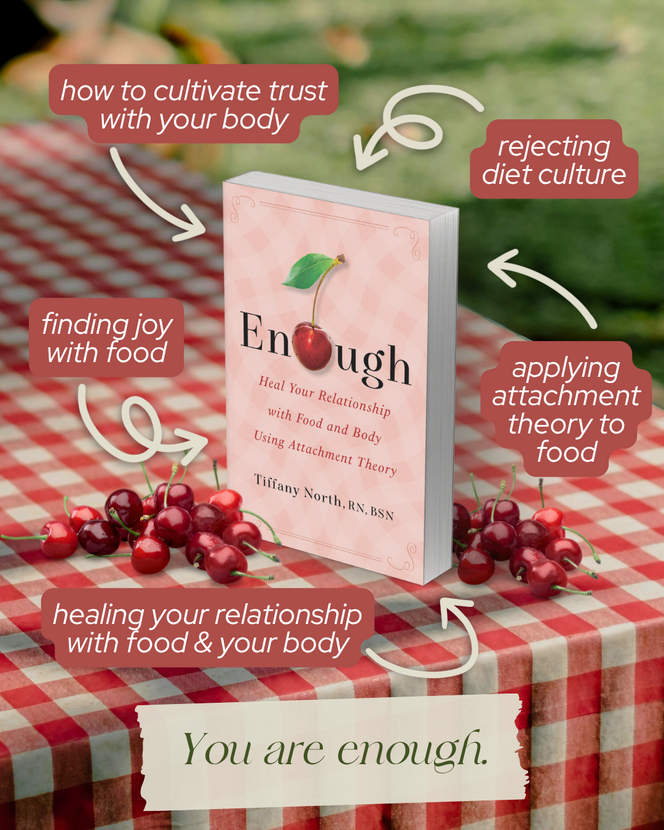
She’d taught her idea, developed and used with clients, and shared at conferences. But it wasn’t until people started asking her when her book was coming out that she thought, “Okay, I guess I’m writing a book!”
She knew that a book would be a great way to spread her message that would also be accessible to many more people but felt totally overwhelmed by the entire process. She was comfortable sending out an email newsletter or making a quick video to post on social media, but writing a whole book?
While she wanted her book to be structured well, interesting, and engaging, she struggled to get it there and realized that she needed some support through the process. She reached out to some friends, one of whom was a former client of mine who introduced us.
The Process
We began by defining the foundational elements of her book: her reader, the point, and her transformational promise.
Her goal was to publish with a small press which meant that she had to craft a proposal and tackle her platform which needed some growth to land a deal. However, she decided that she wanted to write her manuscript first before crafting her proposal. “In hindsight,” she said, “I understand why they do it that way, because the publishing proposals can help you refine your idea, but I needed it to reveal itself before I could answer the questions on the proposal.”
So, she dove in, writing her first few chapters only to discover that she hated her book. She didn’t like writing it, nor did she like what she was writing. In fact, the drafting of the book and those first few chapters was the most challenging part of our work together.
Her frustration led to a big coaching session on style — what style she did like, and why she didn’t like hers. We discovered that she was writing too academically, hiding her voice and being cautious. Essentially, she was trying too hard to sound like an author.
First, we cut her academic tendency to incorporate references to justify each of her arguments. We also pulled the overly technical stuff that wouldn’t resonate with her readers, and she compiled an “Additional Resources” section for those who wanted the supporting studies or information.
Next, we cut or shortened lengthy stories and redundant examples or explanations. She had a tendency to overexplain which spoke to both her academic training and to how women are taught to communicate – to make sure that everyone understands. She had a habit of telling her reader what she was going to tell them, tell them, then would tell them what she just told them. I could clearly see the problem, but it took a bit of practice for Tiffany to be able to identify areas where she was over-explaining and boring the reader.
This is a piece that’s really about trusting your reader, and it can be challenging, especially for first time authors. They sincerely want to make sure that their points are clear but forget that their readers are bright people who will understand. It comes down to really looking at what you want to say and choosing the ONE best way to say it in any given section of your book. Yes, it might come up again later, but you don’t need to repeat yourself.
Finally, we brainstormed ways to add more of Tiffany to the book, and she focused on writing as herself, in her voice.
She added:
- “Yeah, but” sections to address the objections that her clients often voiced (one reader told her that these were her favorite sections and that she felt like Tiffany was “in her head” which speaks to really knowing your reader and writing for them #win)
- Footnotes that were playful and fun to write, where she included her own thoughts or responses to information she had shared
- Original poems on the emotional challenges of dealing with diet culture and healing one’s relationship with food and their body
After revising the first few chapters we’d been working on to the point where she felt confident in her style, voice, and structure, she decided she was ready to finish her manuscript on her own.
Getting Published
When she finished drafting, she reached out for support with her proposal. Some pieces went together easily; others took many many revisions and iterations.
Tiffany had identified the small presses she wanted to submit to. During this phase, the challenge was that each press wanted different elements of the proposal, or they had different requirements on what information to include in each section. She found reworking her proposal for each submission exhausting and frustrating. “It felt like pulling teeth,” she said.
When we started working together, Tiffany was pretty vehemently opposed to self-publishing, a stance she maintained until she was mired in the submission process and feeling discouraged. She shared, “I randomly had a client recommend a self-publishing workshop that was the next day. I happened to be free, so I messaged the person and was like, ‘Hey, can I still come, even though it’s like in 12 hours?’ He said it was fine, so I went.”
The workshop leader was self-published author, River Kai. He walked his workshop participants through the steps and provided a checklist list of all the things to do. Tiffany felt that either she could spend her energy submitting proposals or she could spend it taking steps toward self-publishing. She hired River to walk her through each of the steps as a consultant and found his support invaluable.
Even though she originally said that there was “no chance” she’d self publish, Tiffany is really glad that she ended up taking that route.
When I asked her about hybrid and why she didn’t go that route, she explained that there were things that she wanted to have control over, and the only way she could do that was through publishing her book on her own. Tiffany did hire a designer to do both the cover and interior design, and a copy editor.
Published
The result? Enough: Heal Your Relationship with Food and Body Using Attachment Theory was published August 19, 2025.
It’s such a beautiful book. I’m so proud of Tiffany for sticking with it and finding her voice.

Lessons Learned
From start to publish took almost four years for Tiffany, but she’s found that she loves writing and has another book in mind.
She feels much more confident because she understands her writing process and how she works. She needs to talk through her ideas and any areas she feels stuck. We did do a lot of coaching through Voxer when she felt stuck or frustrated which she found helpful.
She also realized that she didn’t do well with deadlines when it came to submitting pages. (As her book coach, I can verify this 😟). So, she would prefer more talking it out/coaching sessions to keep her going because she found when she missed deadline or got frustrated, she would avoid the work of writing.*
When I asked what she’d do differently on her next book, she shared that she’d have more trust in herself.
Final Thoughts
Every author’s journey from idea to publication is unique and perfect for them. I’m incredibly proud of Tiffany for staying the course, believing in her idea and her self, and writing a beautiful, helpful book that will bring healing to so many.
This is why I do the work that I do. I love working on meaningful books. I also love teaching writing and helping first time authors find their voice and confidence.
If you’re ready to finally bring your book idea to life—just like Tiffany—let’s connect.
*Amy’s footnote – I possibly learned as much from Tiffany as she did from me. Despite the fact that I’ve worked with neurodivergent students for years in the classroom, Tiffany made me question my processes and packages as a book coach to make sure they’re accessible and useful for all writers. She is one of the reasons that I now have a “Book Concept Coaching” package that involves coaching without page submissions where I take extensive notes as clients “talk” through their ideas before writing. This package works really well for neurodivergent folks, for verbal processors, for those who aren’t quite ready to write, or for those who avoid writing if they’re at all confused or feeling stuck.